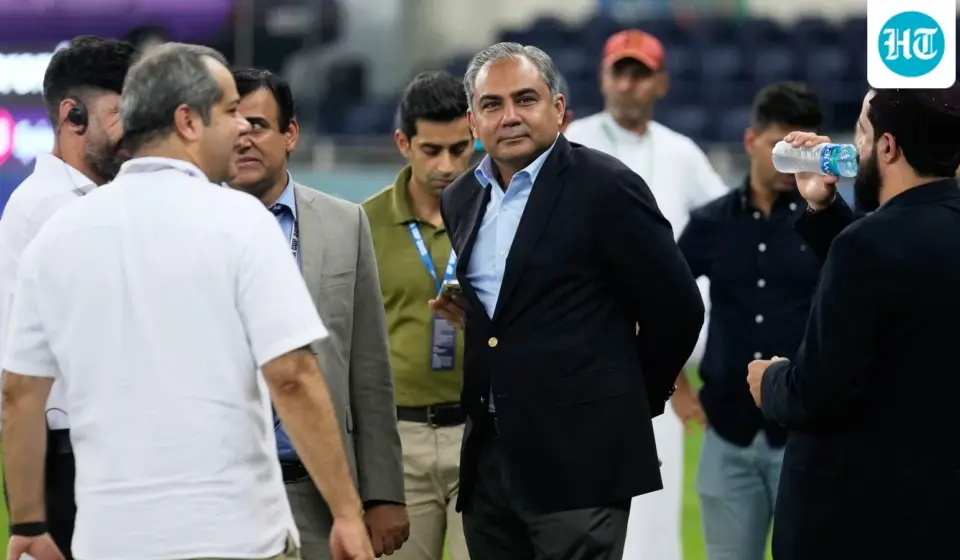
Mohsin Naqvi, chairman of the Pakistan Cricket Board (PCB), has defended the board’s decision to make significant changes to the Pakistan Test squad during its tour of England. The overhaul involved releasing seven players and two coaches midway through the series, a move that drew considerable scrutiny from former cricketers.
The changes followed Pakistan’s losses in the first two Tests against England, resulting in an unassailable 2-0 lead for the home side. Pakistan lost the opening Test by an innings and 103 runs at Headingley, followed by a 194-run defeat at Lord’s. The team also struggled to score 200 in any of their four innings during these matches.
PCB’s drastic measures and Naqvi’s response
After the second Test, the PCB opted for a drastic measure, replacing nearly half the squad. Seven players were sent back: Mohammad Rizwan, Imam-ul-Haq, Salman Agha, Ali Usman, Aamer Jamal, Awais Zafar, and Khurram Shahzad. Of these, Awais Zafar and Khurram Shahzad had not played in any of the matches, while Ali Usman had achieved a five-wicket haul in the Leeds Test. Additionally, head coach Sarfaraz Ahmed and bowling coach Umar Gul were removed from their positions. Saim Ayub and Abdullah Fazal were called up, along with five other uncapped players, with Mike Hesson and Ashley Noffke brought in to manage the Test side for the final match.
Naqvi addressed the criticism, stating that the decision was necessary. He indicated that performance was not the sole reason for the changes and that other matters were under examination, though he did not disclose specific details. He expressed disappointment and pain regarding Pakistan’s decline in world cricket.
Speaking to Geo News, Naqvi stated he was not afraid of criticism, especially from those he felt had not achieved much themselves. He mentioned that he would take remarks from a figure of Wasim Akram’s stature seriously, but dismissed comments from others, suggesting they lacked full knowledge of the situation and had personal issues with him rather than with Pakistan cricket.
Naqvi acknowledged Pakistan’s poor performance in Test cricket, noting the team’s position at the bottom of the World Test Championship (WTC) points table, with only two wins from eight matches. However, he maintained that the team’s white-ball form had improved during his tenure.
Comparing Pakistan’s struggles to other teams
In his defense, Naqvi drew comparisons to other teams’ unexpected losses. He cited instances such as South Africa’s defeat to Namibia and India’s loss to Ireland in a T20I series in June, asking if cricket had “ended” for those teams as well. This comparison, however, garnered significant attention and was described by many social media users as bizarre reasoning.
Critics argued that isolated upsets experienced by other strong teams could not be equated with Pakistan’s Test side, which has faced repeated problems and undergone a sweeping mid-series overhaul. Despite the backlash, Naqvi insisted that the changes were aimed at improving the team, not an admission of a crisis within Pakistan cricket. He affirmed that the board would bring in necessary personnel if current players were not performing.
Naqvi also defended the PCB’s overall record by highlighting progress in white-ball formats. He stated that while the Test match results were not ideal, he believed the team would make progress in the future, similar to advancements seen in ODIs and T20Is. He pointed out that Pakistan had risen from eighth to fifth in ODIs and from ninth to sixth in T20Is since the current coaching team was brought in.
Despite these claims, Pakistan has not reached the semi-finals of an ICC event in men’s cricket since the 2022 T20 World Cup. The team remains at the last spot in the ongoing World Test Championship cycle.
Read Also
Source: hindustantimes.com

Priya Patel writes on politics and current affairs for Latest News, reporting on Parliament, policy and the decisions that affect readers across India.
More articles by Priya Patel